Showing posts with label Shot. Show all posts

3/30/18

Artillery Ammunition-Unusual

In this, our final look at Civil War artillery ammunition, we are going to look at three types that rarely if ever saw field use but was used at sea against sailing ships.  These consist of Hot shot, Chain Shot and Bar Shot. Sadly I lack photographs for Hot and Chain but I do possess one for Bar shot.

Hot shot is actually extremely simple but extremely dangerous to use. Hot shot consists of a solid shot or cannon ball that is made smaller than normal for the cannon it is intended for.  When heated in a special furnace to red or possibly white hot, it is loaded into a cannon with the intent of starting a fire on the enemy warship.  As wooden ships float a solid shot is not likely to sink it. Wooden ships, though, have a tendency to burn easily as they have tar, hemp, and other highly burnable materials not to mention the hull itself.  If the idea was to simply destroy the enemy ship, hot shot was the most effective way.

You may be asking "How the heck can you put a red hot cannonball next to Black Powder? Wouldn't it set off the powder?"  The answer is yes and no.  The hot shot would set it off, if there weren't precautions taken.  To prevent the round from rolling back out as the ship pitched in the waves, wadding of shredded hemp was used to retain the ball. A wad of dry hemp would be placed against the powder charge and then a wet one on top of that.  Then the hot shot is loaded, followed by another wet and then possibly a dry wad.  The theory was that the hot shot would cool in the barrel before it burned through the wet wad.

If you want to disable a sailing ship, the best way to do it is either chain shot or bar shot.  Both serve the same function. Once again being balls smaller than normal for the cannon, this time there are two connected by either a length of chain or a solid iron bar. When fired these rounds would spin through the air, shredding any rigging or men in their way.  Potentially they could even bring down the masts themselves.  Given enough damage in this way, the enemy ship would be disabled and ripe for capture. 
Example of Bar shot.


These types of ammunition, while not seen in field use, are interesting to include here because they were common for several hundred years at sea and in the ammunition magazines of coastal forts. Hot shot was largely replaced by the time of the Civil War by the exploding shell as it was much quicker to make ready, less dangerous to the user, and results were much more rapid in occurring.

-Corporal

Bar shot photograph was taken at the Michiana Pirate Fest. It was taken during the talk abut Black Powder weapons given by Hooka Joe.

Artillery Ammunition-CANISTER!

In this look at Civil War artillery ammunition, we will take a look at antipersonnel ammunition. We will cover two types of ammunition, Grape Shot and Canister. The easiest way to describe these rounds is that it turned a cannon into a giant shotgun, firing multiple sub-caliber balls at the on coming enemy infantry soldiers. The difference between them is number of balls and potential ranges.
Grape Shot

The older ammunition is what is called Grape Shot. This consisted of usually nine iron balls stacked on top of each other and separated by iron plates.  These large, sometimes over two inch diameter in field use, balls had a relatively long range.  Their chief disadvantage was the limited number of projectiles in each round. Part of why it was called Grape Shot was the fact that it was often encased in a cloth bag with twine running between the rounds, somewhat resembling a bunch of grapes.


Canister serves the same function but much more effectively. As of the battle of Gettysburg (July 1-3 1863) the canister round for a Napoleon consisted of twenty-seven 1.5 inch iron balls. This version had a maximum effective range of 400 yards. As the enemy got closer it was not uncommon for the order to be given for "DOUBLE CANISTER!" or even "TRIPLE CANISTER!" This usually happened when the oncoming enemy infantry was getting to less than 100 yards range.  This consisted simply of loading one powder charge into the cannon with multiple canister rounds stuffed on top.  This increased the danger of bursting the cannon itself due to back pressure. At the same time, if the enemy is at twenty yards distant and fully intend to kill me, I think I'd take my chances.

Canister Write up


By late 1863 it was determined that the conventional canister round was not effective enough.  It was rarely used at 400 yards so why have balls inside for that range? The Union developed a version with 78 smaller balls inside for the Napoleon, trading long range for close in lethality and reducing the amount of doubling required.

Components of a fired Canister Round


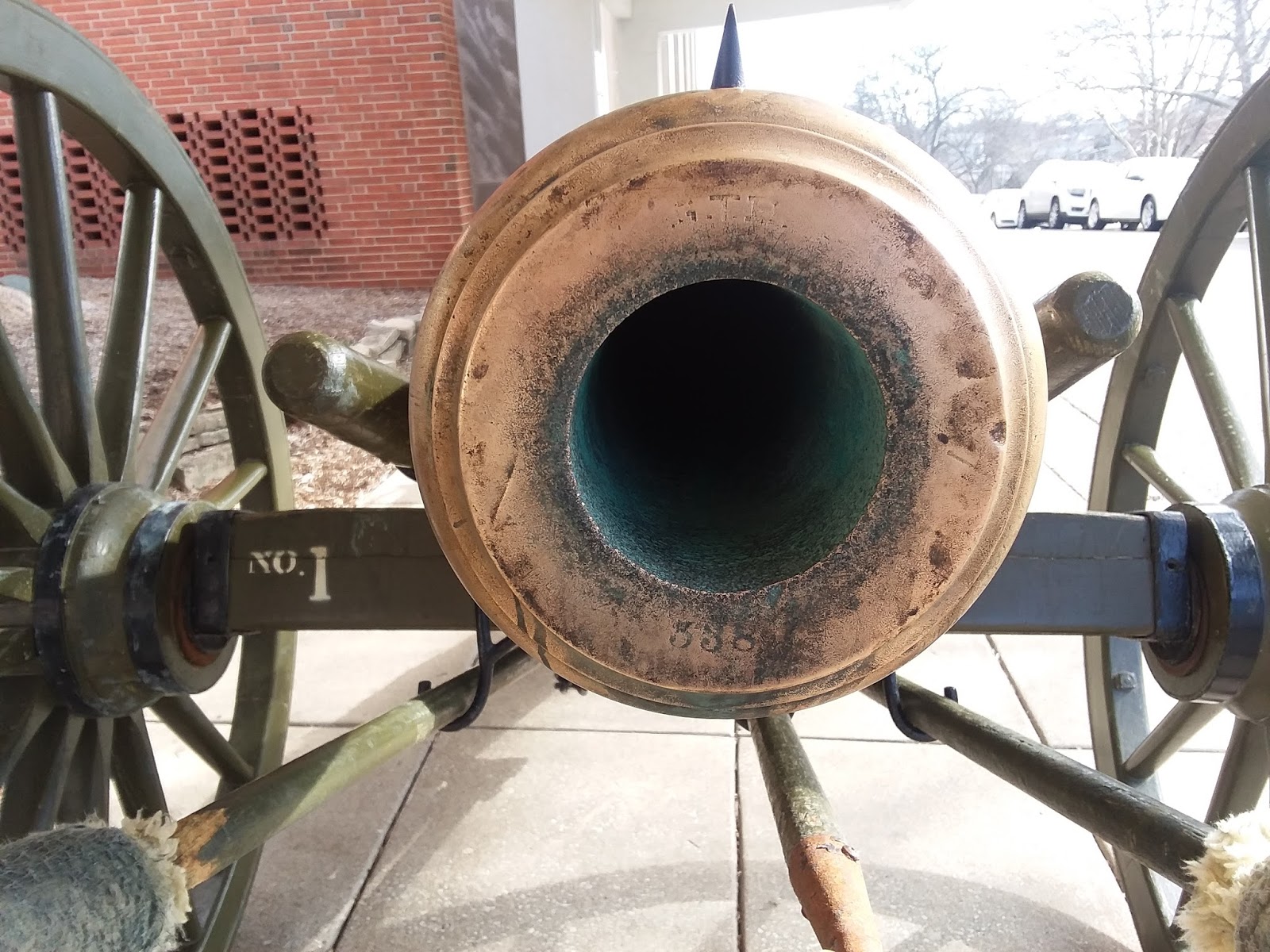
A few side notes. Due to the larger bores on smoothbore guns the canister rounds contained more balls than rifled guns firing similar weight ammunition.  As such while the rifled gun might do damage to the enemy at the start of their advance, up close the smoothbore did the superior damage. At the same time, canister scraped along the walls of the bore when fired. On an iron gun this had little impact but on a bronze gun it often removed metal, resulting in the bore at the muzzle being larger than at the back or breech of the gun.  "Goldie's" muzzle is indeed enlarged so it is possible that she sent many rounds of canister at the enemy.


Goldie (Bronze 6 Pounder)  Muzzle


A final note, most guns only carried five rounds of canister with them into any given battle.  If the battery has gone to canister there likely is no time available to bring up more ammunition from the rear. To supplement the canister rounds the gun crews would press any case shot rounds into emergency service.  Loaded without the fuse the projectile would explode at the muzzle, serving as a reasonable substitute for canister or grape shot.  The common term for this was "rotten shot."  Artillery fuses will be discussed in a later post.


-Corporal

I will apologize for the blurriness of some of the photographs.  I did not realize it until after the event.

3/25/18

Artillery Ammuniton-Shell


The next type of ammunition we will discuss is the exploding shell.

There were two types of exploding ordnance during the Civil War era, common shell and case shot. The basic methods of production were similar but their use and effectiveness were considerably different. In both cases the projectile was cast with a hollow core and some means of fuse installation so it would detonate at the proper moment,


In common shell the cavity is often not very large relative to the body of the projectile. Unlike in later wars the only filler was Black Powder which as previously stated is not an extremely powerful explosive compared to later developments. As such, the destructive power of the common shell was limited. When the round detonates it would often burst into as few as six large fragments, thus limiting the destructive potential. As such it was primarily meant for anti-material work, such as buildings and artillery batteries.


Case shot was produced slightly differently. The central cavity was made larger than common shell and the bursting charge was made smaller. This made for a thinner shell wall so the actual powder charge was sometimes reduced to avoid the risk of it shattering inside the barrel of the cannon. In addition to the Black Powder filler there were iron or lead balls inside as well. The idea was the round would explode over the heads of enemy troops and they would suffer a hail storm of iron to inflict many casualties. As a side note, case shot was invented in the late 18th century by a British artillery officer named Henry Shrapnel. Adopted first by the British in 1803, the basics of the round remained through World War I. Today, any fragmentation is referred to as “shrapnel,” a generalization of the inventors name.


In the post on solid shot we talked about how the rifled projectile was referred to as bolt. While they did exist, they weren't as common as the shell. Indeed, according to the ordnance returns of June 30, 1863 there were no solid projectiles in any Federal rifled batteries with the Army of the Potomac at Gettysburg. Instead there were a high proportion of common shell. The feeling being that the weight was similar enough that if the fuse wasn't armed the effectiveness was much the same as solid shot. Indeed, in November of 1863 the orders were to include 25 shells, 20 case and 5 canister rounds per gun. No solid shot included.

Next ammunition post will be on the most deadly artillery ammunition of all... canister. We will get to fuses, but that will be another post.


-Corporal